The Jan 30th Silver & Gold Price Crash is Set to Worsen Physical Shortages

Within a short 30-minute time span during New York trading on January 29, massive short-selling pressure was exerted on silver and gold prices. Gold dropped 7%, while silver lost 12%, representing some of the largest intraday declines in history.
There were no news events or other indicators that would provide a rationale for such a sudden and concentrated sell-off, which appears to have been designed to push prices lower quickly and trigger further panic selling.
Who sold so much of their metal?
To understand how such price carnage can happen, it is important to understand how futures markets operate and why it is possible for financially strong parties to sell near-infinite amounts of paper gold and silver using leveraged short selling—without providing a single ounce of physical supply to meet physical demand.
Spot prices are set in paper markets and by leveraged shorts
When clients purchase physical metal, we require payment in full and deliver the metal in full—this is a physical transaction. However, prices are not set through physical transactions but by financial derivatives (e.g., futures and unallocated metals), which are more akin to leveraged bets (usually around 10-to-1) and do not require physical metal.
In effect, a party can use USD 1 million to “create and sell” about 100,000 ounces of silver (assuming USD 100 per ounce and 10× leverage). There is no physical metal sale, but for spot price-setting purposes it is as if 100,000 ounces of silver were sold, and this selling pressure pushes prices lower. The short seller never has to produce the silver; they only need to buy the paper silver back at some point.
When the selling of such non-existent silver and gold pushes prices down far enough and fast enough, it triggers stop-loss orders and forced liquidations, accelerating the decline. This is likely what was attempted on Thursday—a massive, precision strike designed to rattle precious-metal markets.
It was therefore a welcome surprise how quickly prices recovered on Thursday morning, as market participants snapped up inexpensive gold and silver positions, creating losses for the short sellers and effectively neutralizing the market-crash attempt.
Yet, after this failed strike, a seemingly endless armada of short-selling “bombers” continued selling leveraged paper gold and silver, pushing spot silver as low as USD 73.3 (a 40% decline), while spot gold fell to a low of USD 4,694 from USD 5,602 (a 16% decline) in less than 48 hours, before making a partial recovery.
Physical supply and demand are largely irrelevant in setting spot prices
As silver has been facing physical shortages - see our October 2025 insight article What the Developing Global Silver Shortage Means for Buyers - and physical gold demand remains exceptionally strong, it is natural for metal prices to rise so that limited physical supply can be matched with physical demand, thereby avoiding shortages.
Physical metal demand is in a secular uptrend as confidence in over-indebted institutions has weakened in many parts of the world, internal political and social strains—including within the United States—have intensified, and geopolitical tensions have reached new highs.
Until unsustainable debt levels are restructured and a new global financial order begins to emerge, demand for physical precious metals—long regarded as a core store of wealth during systemic crises—is likely to continue increasing over time.
The primary function of precious-metal spot price markets is to “discover” the price that best balances metal supply and demand, enabling efficient and orderly markets.
However, today’s spot prices are largely determined by leveraged derivatives (e.g. futures, unallocated metals IOUs) whose trading volumes can be order of magnitudes larger than the underlying physical and allocated metal positions.
As a result, today’s markets:
- Discover prices that primarily settle leveraged IOU positions held by banks and institutional traders
- Do not necessarily discover prices that reflect physical precious-metal supply and demand
This system has functioned for decades because, as long as physical metal can be readily obtained near spot prices, temporary physical mispricing and sustained physical deficits can remain largely inconsequential in the short term.
However, when sustained physical deficits begin to translate into physical supply shortages and spot prices fail to reflect physical supply and demand, shortages can worsen rapidly.
As participants firmly positioned in the physical market, we view the recent surge in leveraged IOU short selling as a significant pricing distortion that does not accurately reflect current physical supply and demand conditions.
This has happened many times before for silver
While the recent leveraged shorting has been unusually large, we have witnessed similar episodes many times since we started Silver Bullion Pte Ltd. One of my insight articles - Silver Shortages Explained - How Physical Demand has Little Effect on Prices - from 2015 described this very same phenomenon 11 years ago.
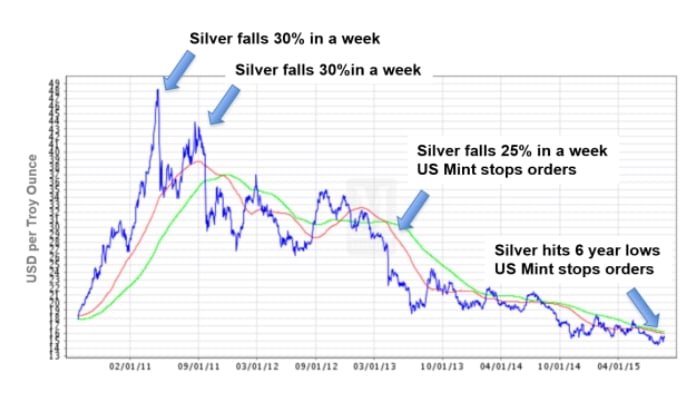
Excerpt from my 2015 article on leveraged short selling and physical shortages
We had similar instances in:
- Q1 2011 – 30% drop in a week; physical sales surged afterwards
- Q4 2011 – 30% drop in a week; physical sales surged afterwards
- Q2 2013 – 25% drop in a week; U.S. Mint stops taking orders, sales surged
- Mid-2015 – paper prices extremely low; U.S. Mint stops taking orders, sales surged
- Early 2020 – 40% drop in a week; paper silver prices crashed, pushing the gold-to-silver ratio to over 120 (the natural physical ratio is approximately 16), making silver the most undervalued relative to gold in human history.
In nearly every instance where leveraged shorts triggered a silver price crash—such as the one observed last Thursday and Friday—physical demand surged afterwards, but spot prices would not necessarily reflect this demand increase, worsening shortages.
We are seeing similar patterns begin to re-emerge now. Consider the following:
- We are vaulting approximately 20 million ounces of silver on behalf of clients, representing around 2% of global annual silver supply. While it is easy for clients to sell back physical silver in volume, our vaulted sell-back activity has remained very limited.
- Although there was some selling pressure during the crash, physical silver demand already exceeded sell-backs by Saturday, despite weekend surcharges and volume limits. By Sunday, the total net volume of physical silver, gold, and platinum transacted since the Thursday crash had already turned positive, meaning we saw more physical buying demand than selling despite the crash.
We expect to place net physical purchase—not sell-back—orders with our suppliers and refinery partners on Monday. This has become a tale of two markets: on one side, there has been massive paper selling pressure; on the other, these low spot prices are re-stimulating physical demand.
What happens next?
Ahead of the January 29 crash, we saw net physical silver demand begin to subside, indicating that silver prices may have been approaching a physical equilibrium level around USD 120.
The high silver price also pushed the gold–silver ratio well below 50, prompting an increasing number of clients who follow the GSR 80–50 rule to switch from silver into gold, thereby releasing some vaulted physical silver supply. However, the recent sharp silver decline has driven the GSR back to approximately 57, greatly diminishing the likelihood of such metal switching.
We are seeing strong purchase interest from clients who are waiting for markets to fully resume trading and for weekend surcharges to be lifted before locking in their transactions on Monday.
As in similar episodes in 2011, 2013, 2015, and 2020, physical silver and platinum shortages are likely to worsen quickly. This is typically accompanied by a growing divergence between paper and physical prices, reflected in higher physical metal premiums. Physical silver prices already appear to be significantly higher in markets such as India, Dubai, and China.
It is important to note that the paper short selling that drove gold and silver prices lower on January 29 and 30 did not provide any physical supply to offset the surge in physical demand at these much lower spot prices.
As a result, many physical markets are likely to begin rationing availability through higher physical premiums in the coming days, weeks, and months.
Regards,
Gregor J. Gregersen
February 1 – Physical Silver, Gold, and Platinum Supply Update
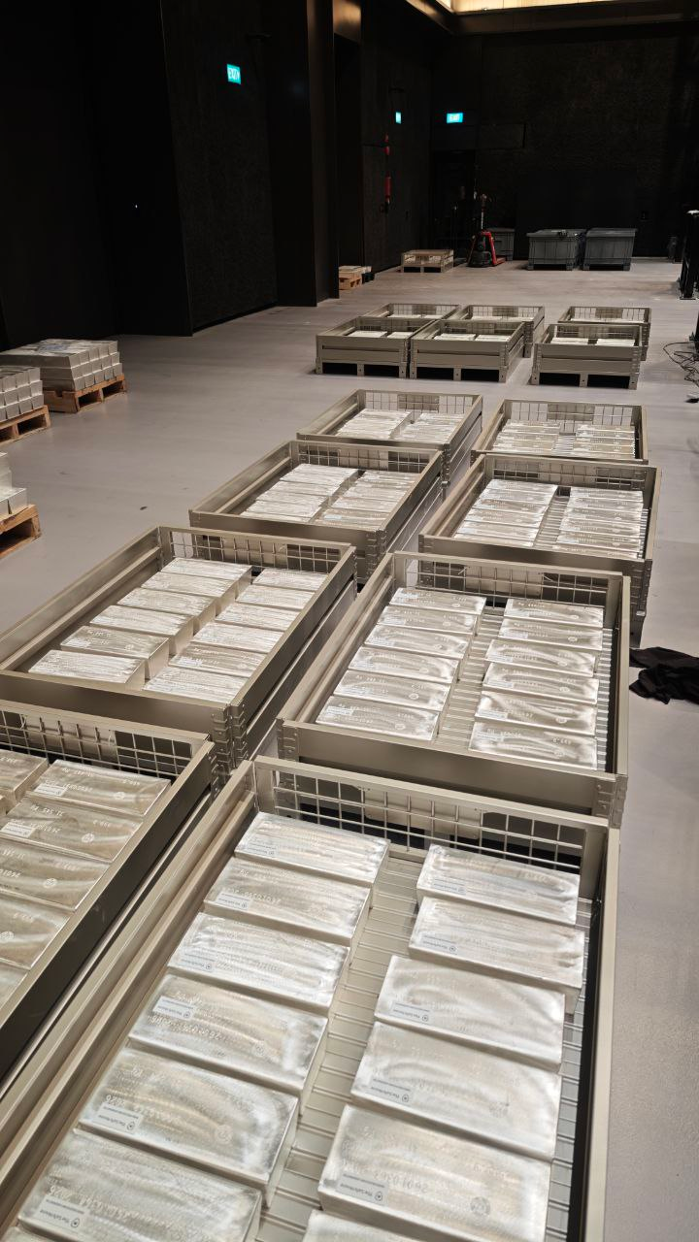
1,000 LBMA good delivery silver bars being added to Silver S.T.A.R. Grams reserved on January 30th, 2026
We have received 22 metric tons of physical silver, covering nearly all outstanding silver pre-orders and providing some in-stock availability. Silver S.T.A.R. Grams now hold a 6-ton excess inventory, allowing for immediate physical positioning. Order closures and pickup notices are also being processed as quickly as possible.
A further 20 metric tons (≈640,000 oz) have been allocated to us from multiple refiners and mints, including The Royal Mint, which has confirmed that we are now the largest seller of Silver Britannia coins in Asia and the second largest for Gold and Platinum Britannia coins.
Gold availability remains solid for 1 kg bars, while platinum availability is currently limited. We will continue to monitor post-crash supply conditions and update availability, premiums, and timelines as required. Should supply conditions deteriorate, we will suspend pre-order acceptance and rely solely on local and vault sell-backs.
Waiting Times, Automation, and Staffing
We ask for your understanding that unprecedented demand—SGD 270 million (USD 212 million) in physical sales in January 2026—means it may take longer to respond to enquiries and process account openings, as we are prioritizing order fulfilment.
We continue to upgrade our processes to better scale with demand. A recent automation of S.T.A.R. parcel sell-back payments, for example, will materially speed up how quickly clients receive payment for bullion sold back to us from February onwards.
As we train additional customer service staff, the situation is expected to gradually improve. If you—or someone you know—may be a good fit to work within the Silver Bullion Group, please contact us at [email protected]. View available positions.
Understanding Order Cancellations
The January 30 price crash has led some newer clients to the industry to attempt to cancel existing orders with the intention of placing new orders at lower price points.
It is important to understand that, as per the agreed terms and conditions, submitted orders are legally binding. This reflects the reality that when client orders are received, we must also lock in corresponding orders with mints and refiners at the time of submission, which cannot be cancelled. Client cancellations would therefore cause a direct financial loss that must be covered by the cancellation fee.
About Pre-Orders and Counterparty Risk
The Silver Bullion Group, which also comprises The Safe House vault and The Reserve facility, is designed to provide the safest place for your gold and silver during a systemic crisis.
Our company inventory comprises over 700,000 ounces of silver and 5,000 ounces of physical gold and platinum, all of which are fully owned by us, unleveraged, and entirely debt-free. We also fully own and operate one of the highest-capacity commercial vaults worldwide and hold net assets exceeding SGD 150 million.
By design, all client bullion is kept off our balance sheet, always tracked by serial number for uncompromising transparency, and can never legally or operationally be used as inventory or sold to others. We are built to excel during crises and to protect client assets well beyond industry standards.
Regards,
Gregor J. Gregersen