Thoughts on the Fall in Precious Metals
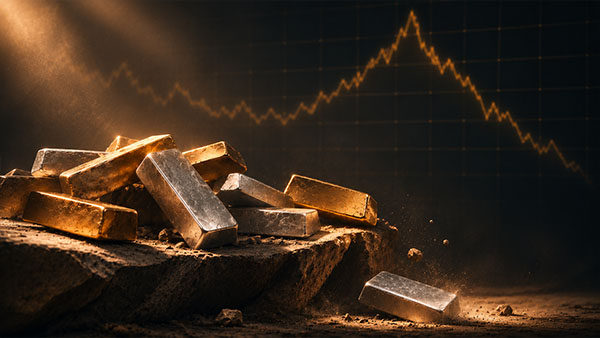
On 20 November silver traded near USD 41.50 per troy ounce, about 66% below its January record of USD 121.62. Gold traded near USD 3,540 per troy ounce, about 37% below its record of just under USD 5,600. Two groups are looking at the same fall and seeing very different things.
The first view The Trader Looks at the Interest Rate
The explanation in the financial press this week is the same almost everywhere. Forbes reported on 16 and 18 November that the metals were falling because the Federal Reserve is expected to raise rates again in December. Kitco's market report of 19 November put Fed rate concerns in its headline. The Rio Times said simply that the reason is interest rates.
The reasoning goes like this. US consumer prices rose another 0.4% in October. The Fed has been raising rates since September. The ten-year Treasury now yields more than 5%, and gold and silver pay no interest. So why hold metal?
For the people who set the price from day to day, this reasoning is correct. Most of them do not own metal, they hold futures and other leveraged positions financed with borrowed money. When rates rise their cost of holding rises, when the price falls they face margin calls, and their results are measured every quarter. So they sell. That is what we are seeing: a fall that is sudden, mechanical and almost entirely on paper.
The second view The Owner Looks at the Currency
The owner of physical metal reads the same facts the other way round. Rates are rising because inflation is rising, and rising inflation means fiat currencies are losing their value faster. That is the very reason to go into physical metals in the first place.
Our clients typically hold their metal for 30 to 40 years, often with the next generation in mind. From where they sit, the reason for owning metal became stronger this month and the price became much lower. Nothing about the metal itself has changed either: the Silver Institute's interim review of 12 November still forecasts a sixth consecutive annual supply deficit.
The bigger picture Government Debt and the Gold Behind It
I believe the world is heading towards more uncertainty, not less. Many government debts are out of control, and it is a matter of time before debts of this size require a restructuring of some kind.
Take the United States as the example. US federal debt passed USD 40 trillion in August and stood at about USD 40.5 trillion in early November. The deficit for fiscal 2026 was about USD 2 trillion, and interest alone cost a record USD 1.36 trillion. Meanwhile foreigners are lending less.
The US Treasury holds 261.5 million troy ounces of gold, still carried on its books at USD 42.22 per troy ounce. Divide the official debt by the official gold reserves and you arrive at about USD 155,000 per troy ounce. Should trust in the dollar fade, and should the US one day need to back a new currency or its debts with its gold, that is the order of magnitude we would be talking about. Against such a number, gold at around USD 3,500 might never quite be as cheap again.
And silver? The US has little to no silver left as a reserve. The government's strategic silver stockpile was exhausted in 2002, and Congress had to authorise the Mint to buy silver on the open market to keep striking coins.
What this means Large Falls Are Part of Long Bull Markets
A fall of this size is not unusual in a long precious metals bull market. In the 1970s gold rose from USD 35 to USD 195, then fell 47% to USD 103 between December 1974 and August 1976, before climbing to USD 850 by January 1980. In 2008 it fell 30% in seven months, from USD 1,011 in March to USD 712 in October, and then rose to about USD 1,900 by 2011. Each time the weaker hands left, and the fall set a new floor from which the next rise began.
Today gold is about 37% below its record and silver about 66%. How deep this fall goes and how long it lasts nobody can say: the 2008 fall took seven months, the one in the 1970s took twenty months. But the reasons for owning these metals have not gone away, they have become stronger.
| Regards, |
| Gregor Gregersen |
| Founder & CEO · Silver Bullion Pte Ltd · Singapore |